AI Humanizer vs Paraphraser
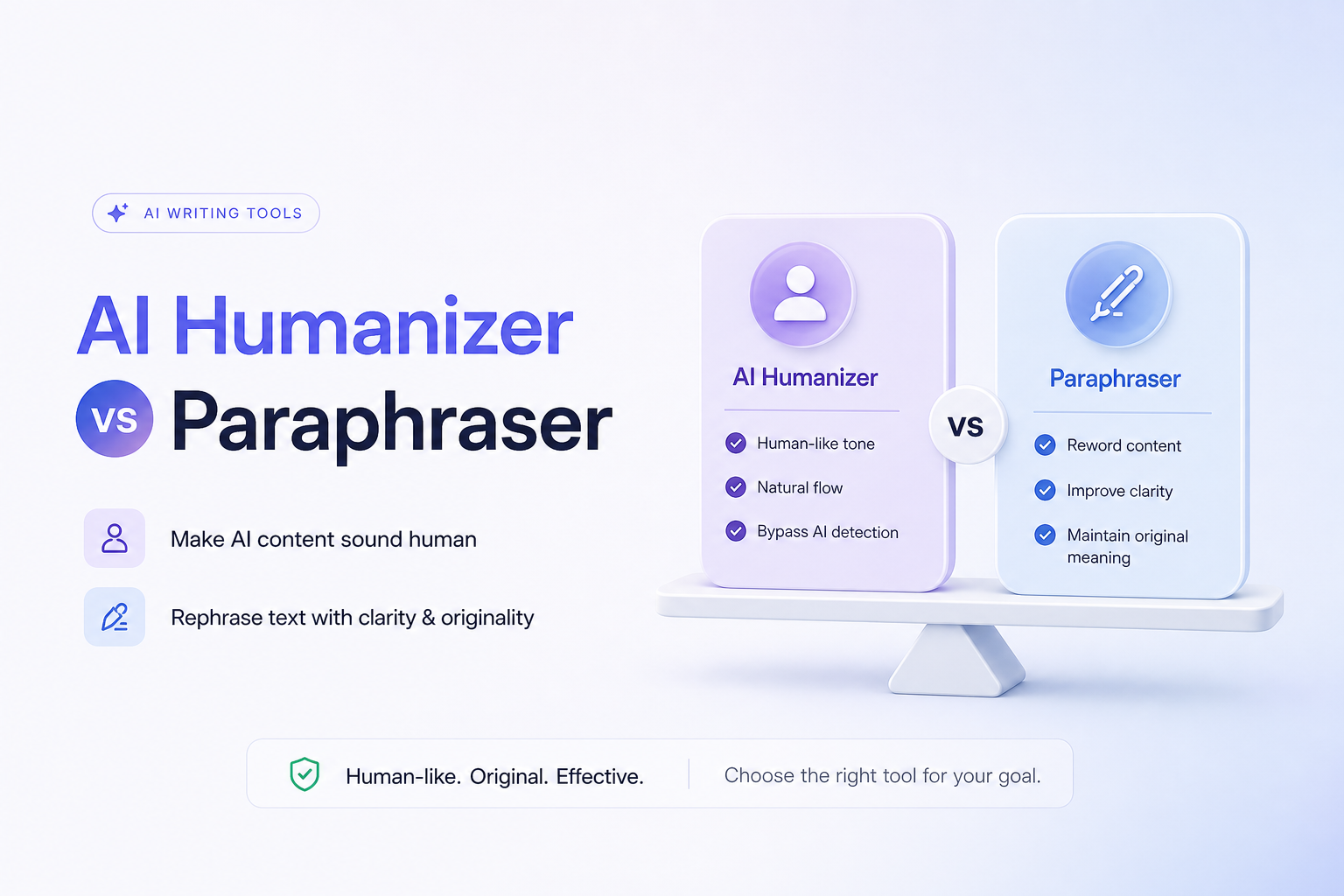
A humanizer fixes stiff delivery. A paraphraser changes how a passage is worded. Here is how to pick one without sending your draft through unnecessary editing loops.
Use an AI humanizer when the message is right but the voice feels robotic. Use a paraphraser when a specific passage needs different wording. If the draft has weak facts or messy logic, fix those problems manually before using either tool.
Do not treat either tool as a plagiarism workaround or an accuracy checker. Review citations, facts, quotations, plus any rules set by your school, client, employer, or publishing platform.
Humanize a Stiff AI Draft → Clever AI Humanizer
Reduces repetitive AI-style phrasing while keeping the central meaning in place · Supports English plus Spanish · Runs in a browser
When an AI Humanizer or Paraphraser Is the Wrong First Step
Editing the surface cannot repair missing evidence, confused reasoning, invented details, or a draft written for the wrong audience. If a paragraph does not have a useful point, making it sound smoother only hides the problem.
Go back to your sources first. Build a plain outline, verify each claim, then decide whether the finished language needs humanization or a small paraphrase.
Choose the Right AI Humanizer or Paraphraser Workflow
Start with the problem you can actually see in the draft.
| Method | Best for | Time | Success rate |
|---|---|---|---|
| 1. Humanize a Stiff AI Draft With Clever AI Humanizer TRY FIRST | Correct ideas with a robotic tone | ~3 min | ● 92% |
| 2. Paraphrase a Specific Passage | Changing local wording | ~4 min | ● 86% |
| 3. Paraphrase First, Then Humanize the Result | Repeated wording plus stiff flow | ~8 min | ● 78% |
| 4. Humanize First, Then Paraphrase Weak Lines | Mostly solid long-form drafts | ~7 min | ● 84% |
| 5. Rewrite the Draft Around Its Real Purpose | Weak logic or high-stakes copy | ~20 min | ● 95% |
Top 5 Ways to Use an AI Humanizer or Paraphraser
01 Humanize a Stiff AI Draft With Clever AI Humanizer
Best when the ideas are solid but the writing feels mechanical
~3 min
Humanize a Stiff AI Draft With Clever AI Humanizer
Best when the ideas are solid but the writing feels mechanical
Choose a humanizer when your draft already has the right facts, order, plus basic message. Clever AI Humanizer focuses on flat tone, repeated sentence shapes, stiff transitions, plus other patterns that can make AI-assisted writing feel unnatural.
- Read the draft once to confirm that its claims, examples, plus structure are correct.
- Open Clever AI Humanizer, then paste up to 3,000 words into the input box.
- Pick a style suited to the document, such as Normal for a blog post or Clear & Structured for a report.
- Select Humanize AI, then compare the result with your original draft.
- Restore any technical terms, keywords, personal details, or intentional phrasing that changed.
- Read the finished copy aloud before publishing it.

02 Paraphrase a Specific Passage
Better for changing wording without repairing an entire draft
~4 min
Paraphrase a Specific Passage
Better for changing wording without repairing an entire draft
Use a paraphraser when one sentence or paragraph is too close to a source, repeats nearby wording, or simply needs a fresh construction. This is a narrower job than humanization, so limit the input to the passage that actually needs revision.
- Mark the exact sentence or paragraph whose wording needs to change.
- Write its essential meaning in a short note before using any tool.
- Place only the selected passage into your paraphraser.
- Choose a clear or standard setting rather than the most aggressive rewrite option.
- Compare the new version with your meaning note, then reject wording that changes the claim.
- Add a citation whenever the underlying idea, finding, or language came from another source.
03 Paraphrase First, Then Humanize the Result
Useful when both the wording plus the overall voice need work
~8 min
Paraphrase First, Then Humanize the Result
Useful when both the wording plus the overall voice need work
A two-pass edit can help when a draft has repeated wording as well as a noticeably synthetic rhythm. Paraphrasing handles the local language change first, while humanization smooths the full passage afterward.
- Save an untouched copy so you can recover details lost during either pass.
- Paraphrase only the repetitive, overly similar, or awkward sections.
- Check names, numbers, quotations, citations, plus technical language against the original.
- Combine the revised sections into one clean draft.
- Run that draft through Clever AI Humanizer using a style that matches the intended reader.
- Perform a final comparison to catch softened claims, altered definitions, or inconsistent terminology.
04 Humanize First, Then Paraphrase Weak Lines
A focused route for drafts that mostly need better rhythm
~7 min
Humanize First, Then Paraphrase Weak Lines
A focused route for drafts that mostly need better rhythm
This order works well if the whole draft sounds stiff but only a few lines remain awkward after humanization. It avoids paraphrasing sections that were already clear enough.
- Correct factual errors, missing context, plus structural problems before editing the style.
- Process the complete draft with Clever AI Humanizer.
- Read the output aloud, marking only sentences that remain vague, repetitive, or clumsy.
- Paraphrase each marked sentence separately rather than processing the full draft again.
- Place the revised sentences back into context, checking nearby transitions plus pronouns.
- Finish with a grammar check followed by a manual proofread.
05 Rewrite the Draft Around Its Real Purpose
The safest choice when facts, logic, or organization are still weak
~20 min
Rewrite the Draft Around Its Real Purpose
The safest choice when facts, logic, or organization are still weak
Neither tool is the right first move when the draft lacks a clear point, relies on shaky claims, or uses a poor structure. Rebuild the content manually, then use a humanizer only for a light final polish if the revised copy still feels rigid.
- Write one sentence stating what the reader should understand or do after reading.
- List the facts, examples, sources, plus constraints that the final version must contain.
- Remove unsupported claims, filler sections, repeated conclusions, plus irrelevant background.
- Reorder the remaining material so each paragraph supports one clear point.
- Rewrite from your notes without looking closely at the AI draft's sentences.
- Use a humanizer on the finished version only if its tone still feels unusually stiff.
Which AI Rewrite Method Should You Use?
Clever AI Humanizer is the sensible first move when your draft is accurate, organized, plus complete but still sounds mechanical. Pick a paraphraser for isolated wording changes. Use both in sequence only when the text has two distinct problems, since every added pass creates another chance for details to shift.
If the reasoning itself is weak, skip both tools for now. Rebuild the draft around verified material, then polish its voice near the end.
Name the draft's main problem before opening a tool: tone calls for humanization, wording calls for paraphrasing, while weak substance calls for a manual rewrite.