Clever AI Detector Tested Against Real and AI-Written Text
Clever AI Detector did more than catch obvious chatbot prose. Its strongest result came from staying useful after AI text had been edited, rewritten, or deliberately humanized.
Clever AI Detector caught 96.7% of 600 AI-involved essays in its published August 2026 benchmark, while none of the 150 human control essays received an AI verdict. The test came from the company, so independent replication still matters, but the disclosed dataset, category results, plus limitations make this unusually useful evidence for a free checker.
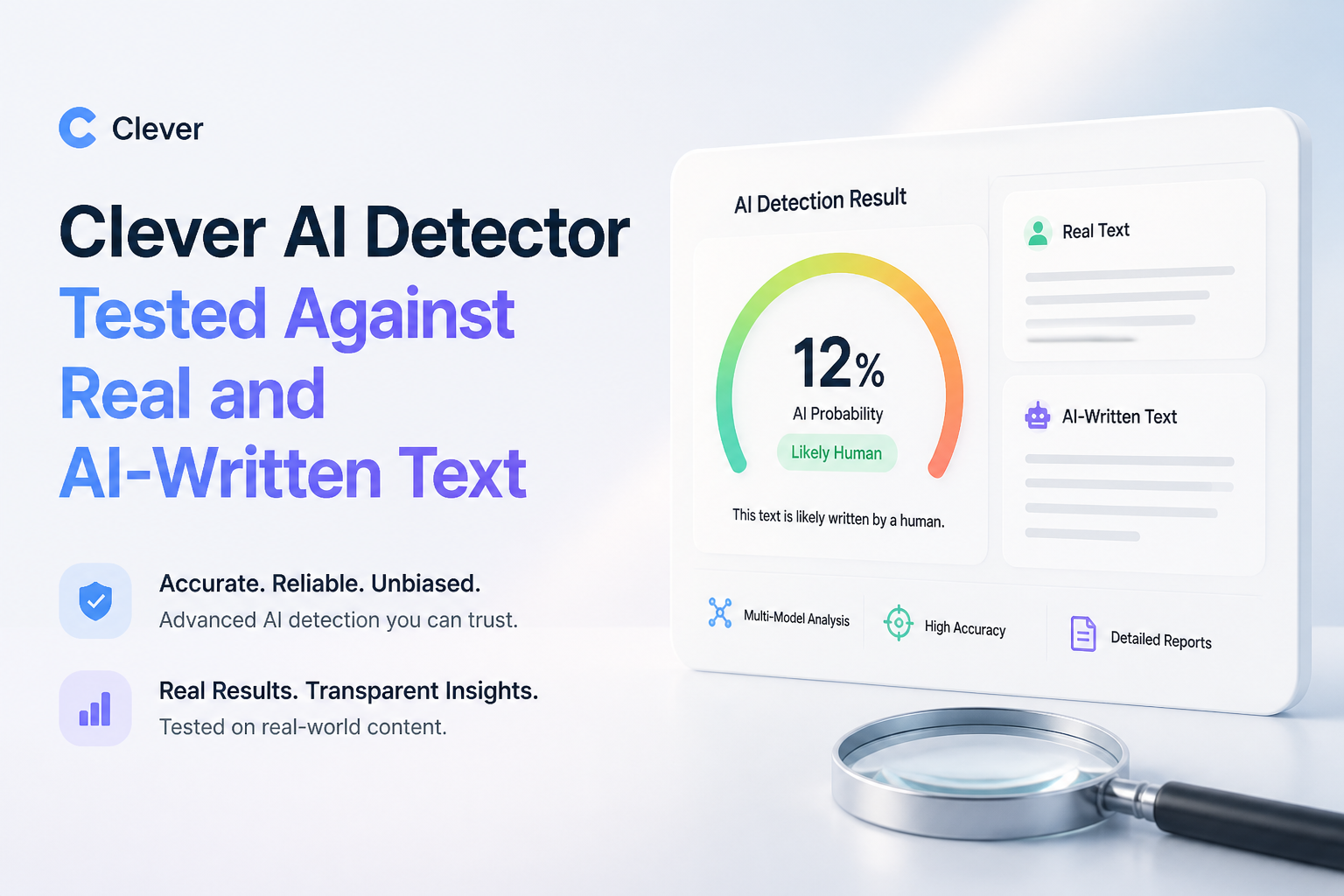
Clever AI Detector at a Glance
9.2/10Clever AI Detector is a browser-based English text checker that estimates the probability of AI involvement. It highlights sentence-level signals rather than presenting its result as proof of authorship.
Best forEditors, teachers, writers, plus content teams needing a free first-pass signal on English text
- Overall AI probability score
- Sentence-by-sentence signals
- Confidence indicators
- Check history with an optional account
- File upload plus pasted-text checks
- High recall in the disclosed GEDE benchmark
- No payment or account required
- Clear uncertainty language
- English only
- Company ran its own benchmark
- A score cannot establish authorship
Clever AI Detector Performance With Human, Edited, and AI-Written Text
01 AI Detection Performance
Strong results beyond untouched chatbot output
9.7/10
AI Detection Performance
Strong results beyond untouched chatbot output
The useful part of this benchmark was not the easy test. Six of eight detectors caught every untouched AI essay, so raw chatbot output barely separated the tools. Clever stood out once the writing had been changed.
Across 600 AI-involved essays, it flagged 580, giving it a 96.7% detection rate. The category results were 100% for direct AI text, 100% for AI-rewritten human drafts, 94.7% for AI-improved drafts, plus 92% for deliberately humanized AI text.
Those figures came from an August 2026 company-run benchmark using the public GEDE research corpus. The methodology is inspectable, though an outside lab should still repeat the test before anyone treats the ranking as settled.
- Caught 580 of 600 AI-involved essays in the published test
- Stayed at or above 92% in every AI category
- Handled edited text better than several familiar detectors
- Performed well on adversarially paraphrased AI writing
- Benchmark execution was controlled by the product's own company
- Results cover argumentative essays rather than every writing genre
- Live detector updates may change performance
02 Human Text Handling
A promising control result with a narrow sample
9.3/10
Human Text Handling
A promising control result with a narrow sample
False accusations matter more than a flashy AI catch rate. Clever did not label any of the 150 pre-ChatGPT human essays as AI in the disclosed control set.
That is encouraging, not conclusive. A zero count across 150 samples can still hide a real false-positive rate of roughly 2.5%, while formal essays do not represent personal emails, fiction, technical notes, or writing from every language background. Clever deserves credit for stating those limits instead of presenting zero errors as a guarantee.
- Zero human essays flagged in the 150-text control group
- Score is framed as probability rather than proof
- Company warns about formal plus heavily edited prose
- Responsible-use guidance discourages automatic punishment
- Human control set was relatively small
- Only one narrow academic genre was represented
- English-language results cannot establish multilingual safety
03 Result Explanations
Enough detail to inspect why a score moved
9.1/10
Result Explanations
Enough detail to inspect why a score moved
Clever gives one overall AI probability, then points to individual sentences carrying stronger machine-writing signals. It also reports confidence, which is more useful than a bare red warning.
The distinction between probability plus proof is explained clearly. A 90% AI score does not mean 90% of the words came from a model. It means the passage's statistical profile closely resembles writing produced by AI. That wording reduces one common source of detector misuse.
- Sentence-level signals locate suspicious passages
- Confidence cues expose ambiguous results
- Copyable report supports editorial review
- Score explanation avoids the percentage-of-words misconception
- Sentence signals still cannot prove who wrote a passage
- No visible model-by-model attribution
- Users may overread a precise-looking percentage
04 Workflow Usability
A simple browser tool with sensible boundaries
8.8/10
Workflow Usability
A simple browser tool with sensible boundaries
The workflow is short: paste or upload English text, run the check, then review the overall probability plus highlighted sentences. No account is required. An optional account saves prior checks.
Each sample must contain 80 to 10,000 words. The lower boundary is reasonable because very short passages provide weak statistical evidence, though it means the tool is not suited to checking a single caption or brief email. English-only support is the main practical restriction.
- No registration needed for a basic check
- Paste plus file-upload options
- Large 10,000-word ceiling per run
- Optional history for repeat users
- English is the only stated language
- 80-word minimum blocks very short samples
- No team review or classroom management features listed
05 Free Access and Limits
Full sentence analysis without a paid gate
9.6/10
Free Access and Limits
Full sentence analysis without a paid gate
Clever AI Detector costs $0. The company lists unlimited checks, up to 10,000 words each, with the probability score, confidence information, plus sentence-level signals included.
There are no paid plans listed for the detector as of September 5, 2026. The company says it sometimes introduces premium features one or two years after releasing a free product, so the current setup should not be mistaken for a permanent pricing promise.
- Complete detector is available for $0
- No signup wall
- Unlimited runs are stated on the product page
- Sentence analysis is not reserved for subscribers
- Free terms could change later
- Service access remains subject to availability
- No paid service-level option for organizations
How Clever AI Detector Was Evaluated Against Human and AI Text
We based the performance review on the August 2026 benchmark published for Clever AI Detector, then checked its methodology, dataset description, category splits, product limits, pricing, plus stated caveats. The benchmark used 750 English essays from the public GEDE corpus: 150 human controls plus 600 texts involving AI at four different levels.
Scores were weighted toward difficult cases, especially AI-edited human drafts plus deliberately humanized AI passages. We gave less weight to direct chatbot output because nearly every serious detector handles that simple case well. Usability, explanation quality, access limits, plus responsible-use language were scored separately.
When Clever AI Detector Should Not Decide the Outcome
Do not use Clever's percentage as the sole reason to reject a student paper, discipline an employee, or accuse a freelancer. The detector finds patterns. It does not have access to keyboard history, drafts, research notes, or the writer's actual process.
For decisions affecting a person, pair the result with version history, earlier writing samples, source notes, plus a short conversation about how the work was created. A borderline score is a reason to ask questions, not a verdict.
Clever AI Detector Scores Across Accuracy, Safety, and Everyday Use
| Category | Performance | Score |
|---|---|---|
| 01 AI Detection Performance | 9.7/10 | |
| 02 Human Text Handling | 9.3/10 | |
| 03 Result Explanations | 9.1/10 | |
| 04 Workflow Usability | 8.8/10 | |
| 05 Free Access and Limits | 9.6/10 |
Should You Use Clever AI Detector?
Clever AI Detector is easy to recommend as a free screening tool, especially for editors or writers who want more than a binary label. Its published results on edited plus humanized AI text are notably strong, while the sentence-level view makes the output easier to question.
Use it for triage, revision, or a second look. Skip it if you need proof of misconduct, multilingual detection, or a formal institutional audit system, because no statistical detector can fill those roles safely.
Check at least 250 words when possible, then inspect the highlighted sentences rather than acting on the overall percentage alone.