SciSpace AI Detector Review
SciSpace wraps its detector in a polished academic toolkit, yet the checker itself feels cramped plus too confident. Clever AI Detector gives longer scans, clearer context, plus better value at $0.
SciSpace AI Detector is easy to read, but its 1,500-word text limit plus uneven calls on edited material reduce its usefulness. Try Clever AI Detector instead for free 10,000-word scans, sentence-level signals, plus no required account.
Do not treat a SciSpace probability score as proof of authorship, misconduct, or undisclosed AI use.
SciSpace AI Detector at a Glance
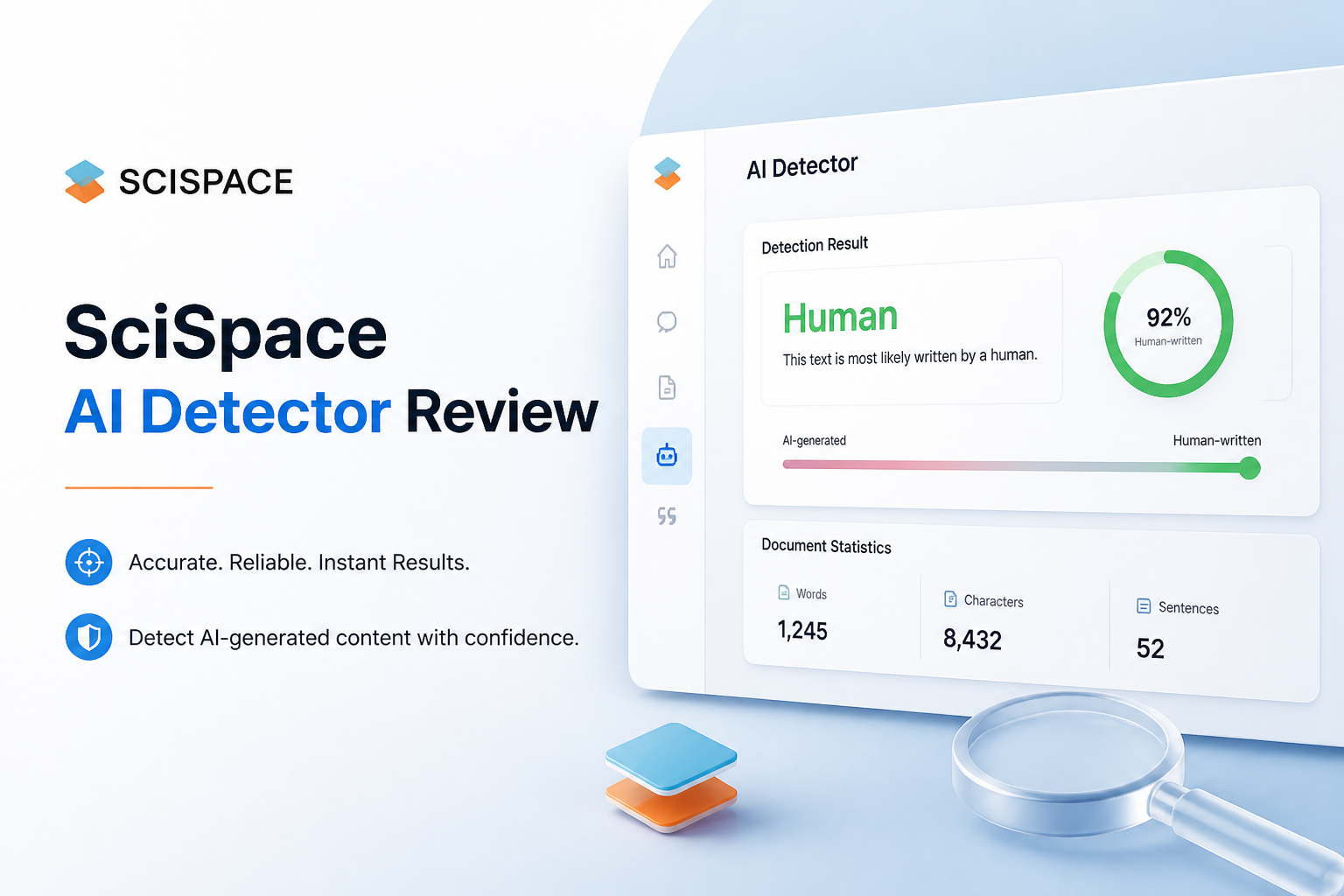
5.4/10SciSpace AI Detector is a browser-based checker aimed at academic plus general writing. It estimates AI involvement, then marks sentences that may have influenced the result.
Best forExisting SciSpace users checking short paper sections or uploaded research PDFs
- Document-level AI probability
- Sentence-by-sentence detection
- PDF uploads up to 50 pages
- Downloadable detection report
- Support for major model families
- Readable line-level flags
- PDF upload support
- Free standalone checker
- Short pasted-text allowance
- Unsteady edge-case verdicts
- Scores can appear more certain than they are
How We Evaluated SciSpace AI Detector
We reviewed the detector with several writing patterns rather than relying on untouched chatbot output alone. The set covered plain human prose, formal academic paragraphs, direct model output, lightly edited AI copy, quoted material, plus passages mixing human writing with generated sentences.
Scores reflect detection consistency, explanation quality, usable document length, workflow friction, plus free access. Published product limits were checked against current official pages in October 2026. No detector result was treated as proof of who wrote a passage.
When SciSpace AI Detector Is the Wrong Tool
Skip SciSpace if you need to scan a full thesis chapter, review many submissions, or make a disciplinary decision. Its 1,500-word pasted-text limit creates avoidable splitting, while probabilistic flags are not strong enough to support accusations.
It is also a poor fit for confidential manuscripts or sensitive workplace text unless your organization has reviewed the service's current privacy terms. For low-stakes self-checking, remove names, unpublished findings, plus personal details before using any online detector.
SciSpace AI Detector Scores Across Five Review Categories
| Category | Performance | Score |
|---|---|---|
| 01 Detection Reliability | 4.9/10 | |
| 02 Result Explanations | 7.1/10 | |
| 03 Document Handling | 6.1/10 | |
| 04 Workflow Usability | 6.7/10 | |
| 05 Free Access Value | 4.4/10 |
SciSpace AI Detector Performance in Real Writing Scenarios
01 Detection Reliability
Straightforward samples fare better than messy real drafts
4.9/10
Detection Reliability
Straightforward samples fare better than messy real drafts
SciSpace handled obvious, untouched AI prose more convincingly than mixed passages. Trouble appeared once a draft included quotations, citations, personal wording, or light human revision. Those are normal features of academic work, not unusual stress tests.
The score looks precise, though that precision can overstate what the tool knows. An AI probability is a pattern estimate, not authorship evidence. One real App Store reviewer also reported that pasted ChatGPT text received a 0% AI result, which matches the wider concern about occasional misses.
- Recognizes many plainly generated passages
- Provides a document-level probability
- Designed with academic prose in mind
- Edited AI text can produce unstable calls
- Human academic phrasing may resemble model output
- A precise percentage can invite overconfidence
02 Result Explanations
The strongest part of the checker
7.1/10
Result Explanations
The strongest part of the checker
SciSpace does more than display one alarming number. It identifies sentence-level signals, reports an AI-use probability, plus offers a downloadable report. That makes review faster because readers can inspect the passages affecting the result.
The weakness is interpretation. A highlighted sentence shows where the model noticed a pattern, but not reliable proof of why that pattern exists. Formal transitions, restrained tone, repetitive methods language, or non-native English can all look statistically regular.
- Sentence-level detection narrows the review
- Downloadable reports help with record keeping
- Layout is easier to scan than a plain score
- Limited explanation of model uncertainty
- Highlights may be mistaken for evidence
03 Document Handling
PDF support helps, though pasted text runs out of room quickly
6.1/10
Document Handling
PDF support helps, though pasted text runs out of room quickly
SciSpace accepts pasted text plus uploaded documents. Its published allowance is 1,500 words for text or 50 PDF pages. PDF support suits research papers, especially if the document already lives inside a SciSpace workflow.
The pasted-text ceiling is the bigger issue. A thesis chapter, journal draft, long report, or several student responses may need to be split into pieces. That creates extra work plus can change the context used for each result.
- Supports direct PDF uploads
- Handles papers without manual copying
- Fits short essays or paper sections
- 1,500-word pasted-text ceiling is restrictive
- Splitting a document can distort the overall reading
- Batch review is not the detector's strength
04 Workflow Usability
Clean enough for one-off checks
6.7/10
Workflow Usability
Clean enough for one-off checks
The detector feels familiar within SciSpace. Paste or upload a document, run the check, then review marked lines. Researchers already using Chat with PDF or Literature Review may appreciate keeping another task in the same browser workspace.
That convenience matters less for anyone who only needs detection. The surrounding research platform adds navigation without improving the core judgment. Clever AI Detector offers a shorter path from pasted text to an explained result.
- Readable results page
- Low learning curve
- Convenient for existing SciSpace users
- Broader platform feels unnecessary for detector-only use
- Limited text capacity interrupts long-document review
05 Free Access Value
No detector fee, yet the allowance trails a stronger free rival
4.4/10
Free Access Value
No detector fee, yet the allowance trails a stronger free rival
The standalone detector is presented as free, so the problem is not an upfront price. The problem is what users receive for $0. SciSpace permits 1,500 pasted words, while Clever AI Detector currently accepts up to 10,000 words per run with unlimited checks.
SciSpace may still make sense for someone already using its research suite. As a dedicated detector, though, its free access feels less generous plus less focused than the alternative.
- Standalone checking is available for $0
- No separate detector purchase is listed
- PDF uploads add some practical value
- 1,500-word text allowance feels tight
- Clever offers substantially longer free checks
- Value depends heavily on using other SciSpace tools
SciSpace AI Detector vs Clever AI Detector: Head-to-Head Results
We compared both browser tools using the same types of English material: human prose, untouched model output, edited AI passages, plus mixed drafts. Limits come from each product's published information as of October 2026.
| Metric | SciSpace AI Detector | Clever AI Detector |
|---|---|---|
| Maximum Pasted Text | 1,500 words | 10,000 words |
| Sentence-Level Signals | Included | Included with reason cues |
| Mixed-Text Review | Less consistent | Better separation of sentence signals |
| PDF or File Input | PDFs up to 50 pages | File upload supported |
| Result Framing | AI probability plus flagged lines | Probability, confidence, plus line cues |
| Required Account | Sign-up prompts appear in the wider platform | None for basic checks |
| Detector Price | $0 | $0 with unlimited checks |
| Overall Score | 5.4 / 10 | 9.1 / 10 |
What to Use Instead
Clever AI Detector is the better first stop for editors, students, instructors, or writers who need longer free scans plus more context around individual sentences.
01 Clever AI Detector
A more useful free check for long English drafts
9.1/10
Clever AI Detector
A more useful free check for long English drafts
Clever AI Detector accepts up to 10,000 words per run with no detector paywall or required account. It reports an overall probability, marks sentence-level signals, plus gives reason cues that help users inspect awkward sections instead of panicking over one number.
Its published August 2026 benchmark reported correct flags for 96.7% of 600 AI-involved texts, with zero false positives in a 150-text human control set. The test still has limits, so Clever should remain a screening aid rather than proof.
- Free unlimited checks in the browser
- Up to 10,000 words per scan
- Sentence-level signals with reason cues
- No account needed for basic use
- Clearer treatment of uncertain results
- English is the main supported language
- Its published benchmark cannot cover every genre
- No AI detector can establish authorship

What SciSpace Users Report Online
An App Store reviewer said pasted ChatGPT material received a 0% AI result, which made the detector look unreliable in that test.
One r/PhD user said SciSpace mixed up simple concepts during literature-review work, though the complaint covered the wider platform rather than only its detector.
A user looking for thesis-checking tools described SciSpace's free similarity plus AI check as useful for getting a rough indication, while warning that it was not perfect.
A discussion reported that SciSpace labeled an old Charles Dickens passage as fully AI-generated, illustrating why historical or highly patterned prose can confuse detectors.
Should You Use SciSpace AI Detector?
SciSpace AI Detector is acceptable for a quick look at a short passage or uploaded academic PDF. It fell short on practical scan length, nuanced mixed text, plus the level of certainty implied by its percentages.
Existing SciSpace subscribers may keep it as a secondary signal. Everyone else should start with Clever AI Detector, which offers longer free scans, clearer sentence feedback, plus fewer barriers.
Run the complete draft through Clever AI Detector first, then manually review every flagged sentence before making edits or drawing conclusions.